It’s nearing the end of February, and I am so eager to get outside and work in the gardens. I love gardening at this time of year. Of course reality clashes hard, because as mentioned previously, we are moving. We need more land to grow on, and we need privacy and security for the sake of our peace of mind and the health of our animals.
So instead, the works of packing and moving, fixing and improving have taken priority. I already lifted and potted a few dozen plants in October, and have about a hundred or two more. I’ve taken scion wood for a much larger orchard somewhere else, and will be lifting the roses, smaller evergreens, and other beauties as we near our departure. I don’t dare start more seeds, as we already have several large wooden planters of cold-stratifying fruit seeds started.
I thought this might be a good opportunity to give some background.
I started steam distilling herbal hydrosols in 2015, starting with a seedy-looking lab glass set I ordered on discount from a science lab equipment store and a basket of rogue spearmint growing outside our rental. It wasn’t great – but it was a good start. I later distilled our Christmas tree, carefully cutting the needles of each branch with scissors, and gifted a quart to my now-deceased uncle. He was a bit of a madman, but had been like my father. His excitement at this healthy home cleaner made me very happy, despite the fact that he used it all up within days.
I upgraded to a 1.5 liter copper still from Malle-Shmickl in 2020, after years of poring over their Essential Oil Maker Handbook. My first attempt was with yarrow, and since then I’ve distilled another few dozen varieties of plants, improving my technique each time.
I had played with the idea of herbal skincare starting in 2014, but a basic cost/profit analysis told me I had more work to do. I took a soap making class in 2016, but the thought of using a bottle of olive oil, coconut oil, and fine exotic essential oils was unreasonable. Why couldn’t I make things with locally grown ingredients? Were these exotic oils really necessary for healthy skincare? Why do I have to take from places overseas that are being strong-armed and exploited? So I started growing and learning as much as I could, with an emphasis on skin tonifying and adaptogenic herbs. I visited the library every three weeks and took books of notes.
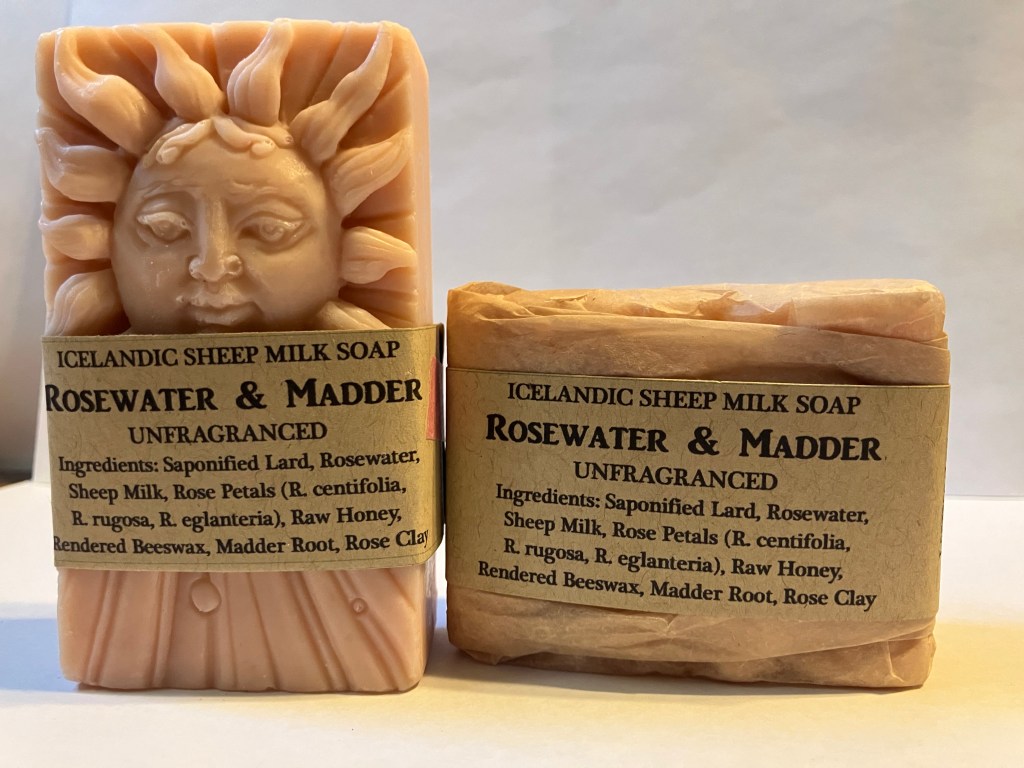
We started raising Icelandic sheep in 2022, and breeding/milking the sheep in 2024. 2023 was a bit busy with the birth of my second child. Sheep milk is simply wonderful, even with its limited supply (about 2 cups per ewe per day) and I started making cold process soap using lard I rendered from slabs of local pork fat, hydrosols, and sheep milk that same year. I started without using any scents, which did not appeal to most market goers!
I figured out ways to incorporate stinging nettles, fresh green oats, wild grape leaves, chamomile hydrosols, double distilled Rosewater, madder root, homegrown strawberry pulp, yarrow hydrosol, oyster mushrooms, plantain leaves, and other skin-beautifying ingredients, but the lack of fragrance meant people didn’t read the labels. Fair enough, I love a good challenge!
Figuring out essential oils and fragrances has been tricky and expensive, but fun all the same.
I started producing sheep milk lotion in December 2024 for home use. It was great! I loved how it hydrated my winter-dry skin and gave my face an even glow, with a subtle dewy effect. It seemed to soothe reddened areas, and I noticed small scratches and irritations cleared up more quickly. I was happy with how long it lasted (I was still using some as a body lotion in October 2025 (10 months) though I’d suggest using it within 6-8 months. After running out of frozen sheep milk (I triple filter it and deep freeze immediately – my method of lotion making includes a pasteurization step), I had to wait for a new lambing season.
This year I expanded my tests and recipes, incorporating more ingredients like Sophora flavescens root, cleavers (Galium aparine), and sea buckthorn seed oil, all especially well-suited for the face and for encouraging a clear complexion.
I also found a good source for essential oils, conveniently located in our nearby town. The store owner is very particular about sourcing authentic and often organic essential oils, ideally under ethical trade agreements, which is critical to me. Essential oils come from huge quantities of plant material – they’re very potent and can cause as much harm as good. I’ve also spent hours and hours scouring through a massive text titled Essential Oil Safety, and the dangers of adulterated products are not worth the risk.
Of course we’ll likely be unable to visit that store in the future, but the importance of sourcing quality essential oils is still important.
Here are a few products I’ve developed this year:
Lightweight Face/Body Lotion – Rosemary: I formulated this one to be light and hydrating for the face and delicate skin of the front chest (the décolleté). A combination of Rosewater and lemon balm hydrosols and sheep milk are the base, with special additions like sea buckthorn oil and cleavers oil, along with organic rosemary essential oil. Emulsifying waxes are crucial for a stable lotion, but this recipe contains just enough to hold it together. Too much emulsifying wax can cause clogged pores. A brief freeze while at a market on a cold day led to some hydrosol separation in my last batch, but a quick shake is enough to mix it up. I like to use this one on my kids, especially during the cold/flu season. It can sting slightly on irritated skin due to the apple cider vinegar (our skin is naturally acidic, and pH imbalances can cause visible distress) but it’s been very good for my whole family.
Rose Patchouli Body Lotion, Rose fragranced and unscented : This one has had great feedback, and I love using it before bed or after a shower. It’s packed full of a variety of oils, it’s little heavier, but it absorbs quickly and hydrates nicely. I grew a patch of patchouli from seed this year, and rose scented geraniums grow happily in the greenhouse.
I should note – my difference between body lotions and face lotions are the oils and fats used – some are more likely to lead to clogged pores, but can be more deeply hydrating for thicker dry skin like on the feet or knees. Also some hydrosols, like lemon balm, are more tonifying to the skin, which becomes more relevant for our face.
Lastly I’ll just mention the sheep milk face cleanser I put together. I use this formula every day, generally once, and it’s been very satisfying. You only need about a half teaspoon per use, so a 7 oz bottle has lasted me months. I generally don’t wear makeup, but Halloween called for a face full, and this cleanser removed all of it! The cleansing action comes from a small amount of borax powder, and the sheep milk and hydrosols soothe and hydrate at the same time as cleaning. I usually follow this up with the lightweight face lotion.
I also have a ginger lily enfleurage lip balm that I’m very happy with. It’s a vegetarian option (most of my lotions include a small amount of lard for its intense moisturizing properties). Enfleurage is a lovely process of laying dozens or hundreds of fragrant flowers on fat, which absorbs the full scent, over the course of weeks or months. I started practicing this in 2019, and finally made a product I can market.
Well that’s all I have to say for now! If interested in any of these products, keep an eye on my Facebook page, Facebook.com/GreenPhoenixFarmProducts. I’ve taken down my listings for now, as packing up our life has made packing up shipments too difficult.
Thanks for reading! I hope you have some good dreams to create and follow.
Live in truth, keep a clear head, and you’ll find a good path.

 Green Phoenix Farm Products
Leave a comment